Pinterest GenAI Controls
Overview
Generative AI (GenAI) is rapidly changing visual discovery, and Pinterest is investing in giving users more control over their GenAI experiences.
Pinterest users have told us they want more transparency and control over how often AI-generated content appears in their home feeds. In response, the team has been evolving user feedback experiences to give people clearer ways to express their content preferences.
Overall, this initiative aims to strengthen user trust and engagement while building a more sustainable approach to GenAI content on Pinterest.
Our goal
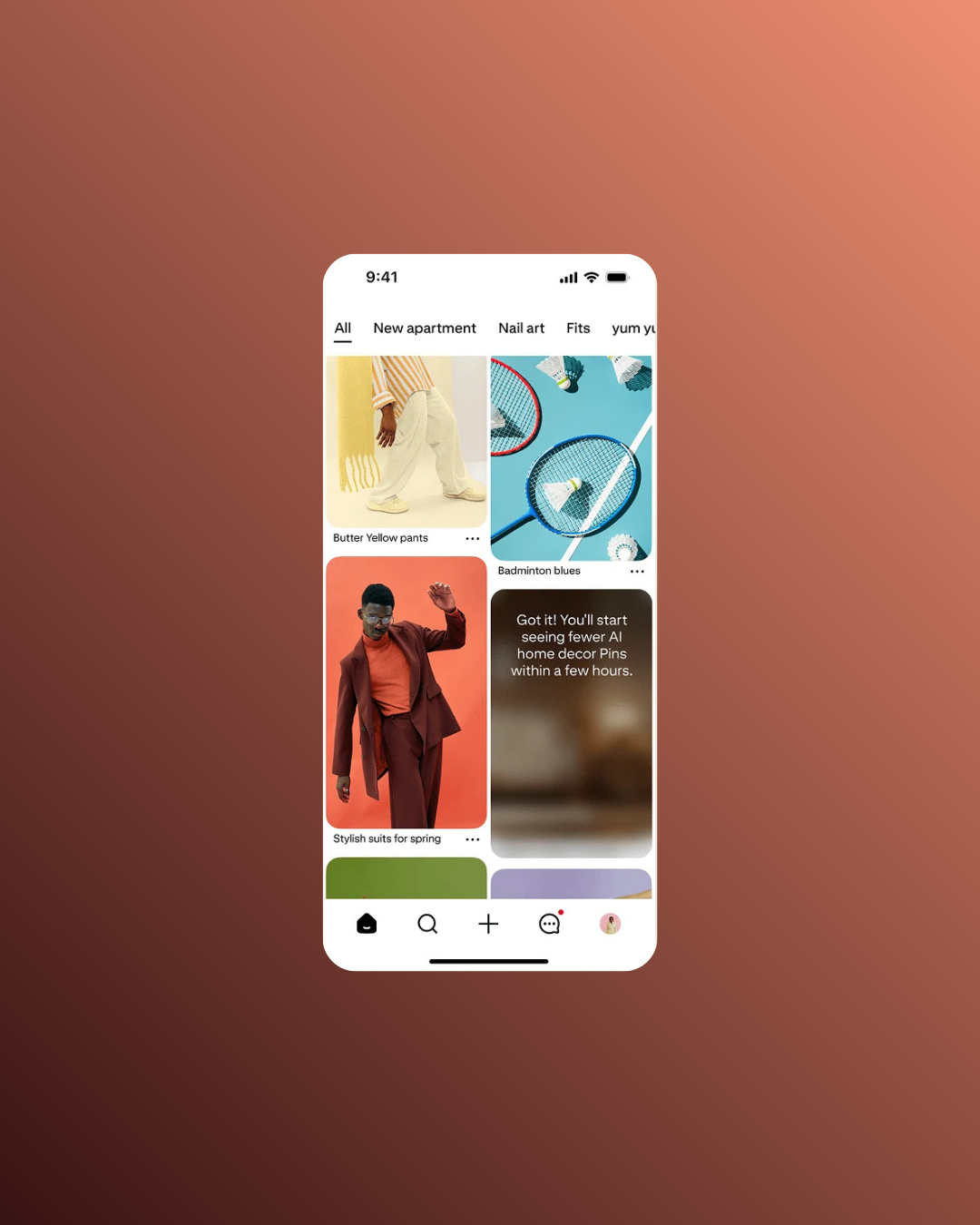
Make it easier for people to personalize their home feeds by adjusting how often specific types of AI-modified content, or Pins, appear. Focus on clearer messaging across settings, confirmation toasts, overlays, and flyouts.
My role
Previously, I collaborated with Design and Product to develop and test user feedback terminology through UXR. I played a significant role in developing a framework and rationale that invited people to express whether they want to “See more” or “See less” of specific types of content.
Most recently, I’ve been collaborating with Product, Design, and Engineering to iterate on the “See more/See less” framework” and test GenAI controls positioning that’s clear, compliant, and resonates with users.
Impact
The “See more/See less” framework I’ve helped streamline the language for has become a foundation for Pinterest’s content controls experience. This experience has reached 30M users to date, with over half of users who click through taking a control action. Today, this work is helping Pinterest build trust around GenAI while creating a clearer, more scalable approach to content personalization.
Pinterest Social Notifications
Overview
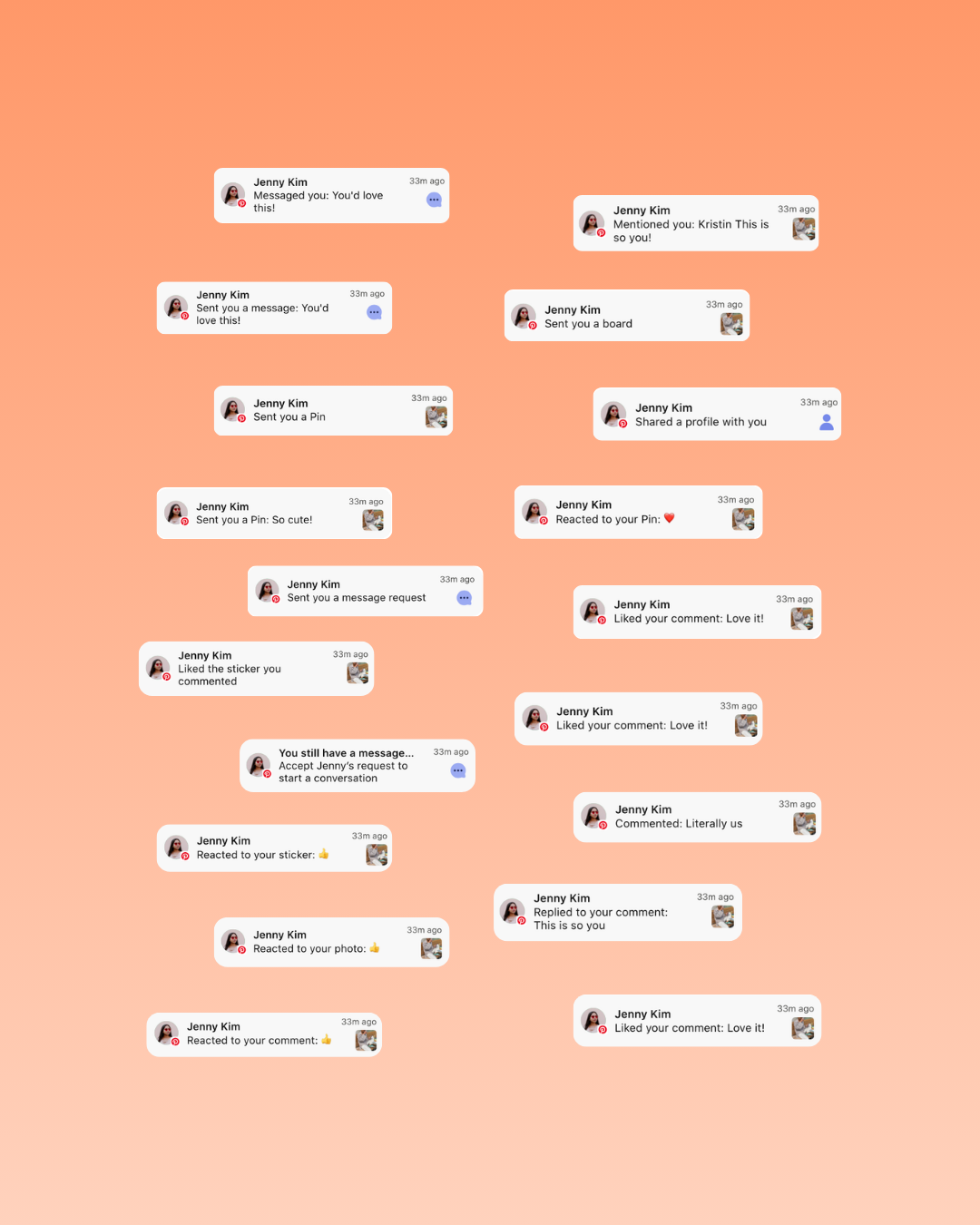
Social notifications had been collecting dust for years. As a result, they were outdated, pretty generic, and struggled to resonate with users. In January 2026, the team created a plan: 1) update notifications with more descriptive and engaging copy; and 2) test notifications across three groups: sending messages, sharing content, and posting comments or reactions.
Our goal
Create notifications that are more clear, more engaging, and more relevant for users. Aim to increase engagement, and overall MAU and WAU metrics.
My role
After analyzing our set of ~20 notification types, I found inconsistencies in formatting, punctuation, and emoji usage across existing social notification copy. Drawing on UXR insights and guidelines I’d developed with the Notifications team (later incorporated into a notifications playbook by my design partner), I outlined a new framework with clearer formatting standards and revised notification copy.
Impact
Over the course of 5 months, the framework drove increases in notification engagement, including a +1.68% increase in push notifications opened and a +1.5% increase in comment mentions. As of May 2026, this work contributed to +96K global WAU and +23K global MAU. The team continues to iterate on the framework for future social notification experiments.
Pinterest Phone Collection
Overview
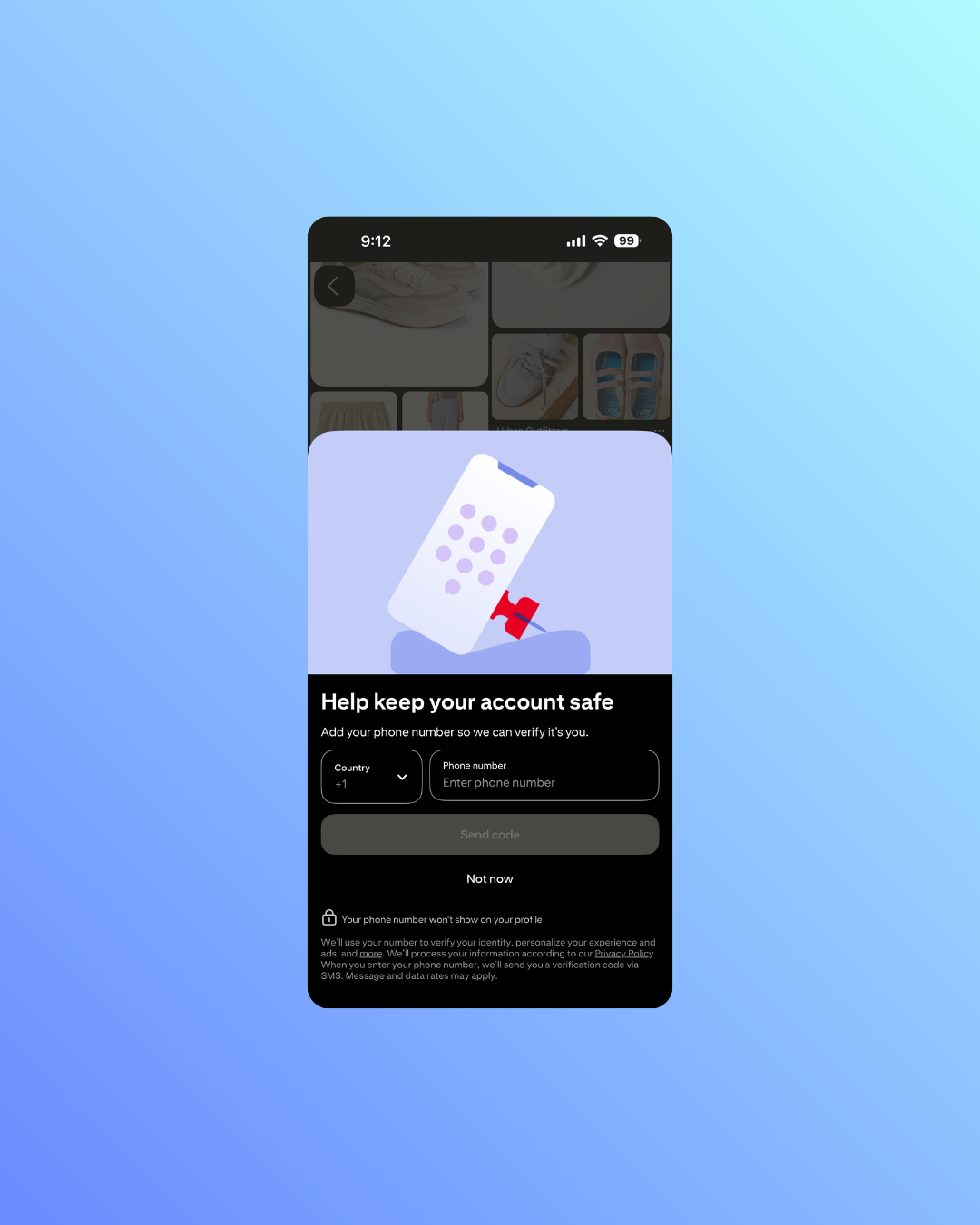
Pinterest needed to build a stronger foundation of verified phone numbers to support monetization, social growth, and future authentication experiences. However, asking users for a phone number can create significant friction, so the team initially focused on building trust through clear value propositions and transparent messaging.
Our goal
Design a phone collection and verification experience that balances Pinterest’s business goals without sacrificing user trust. Develop and test compelling value propositions that resonate with users, minimize friction, and increase the rate of phone collection.
My role
I collaborated with Design leadership, Product, Engineering, and Legal to craft value prop variants for testing. The team used the highest-performing copy in the final experience to help reduce friction and optimize the phone collection process.
Impact
Pinterest has collected almost 4M user phone numbers to date. My content design work has contributed to the groundwork for new social features projected to bring in over 100K new users. Looking forward, this broader initiative is continuing to establish phone numbers as a foundation for future authentication and account recovery experiences.